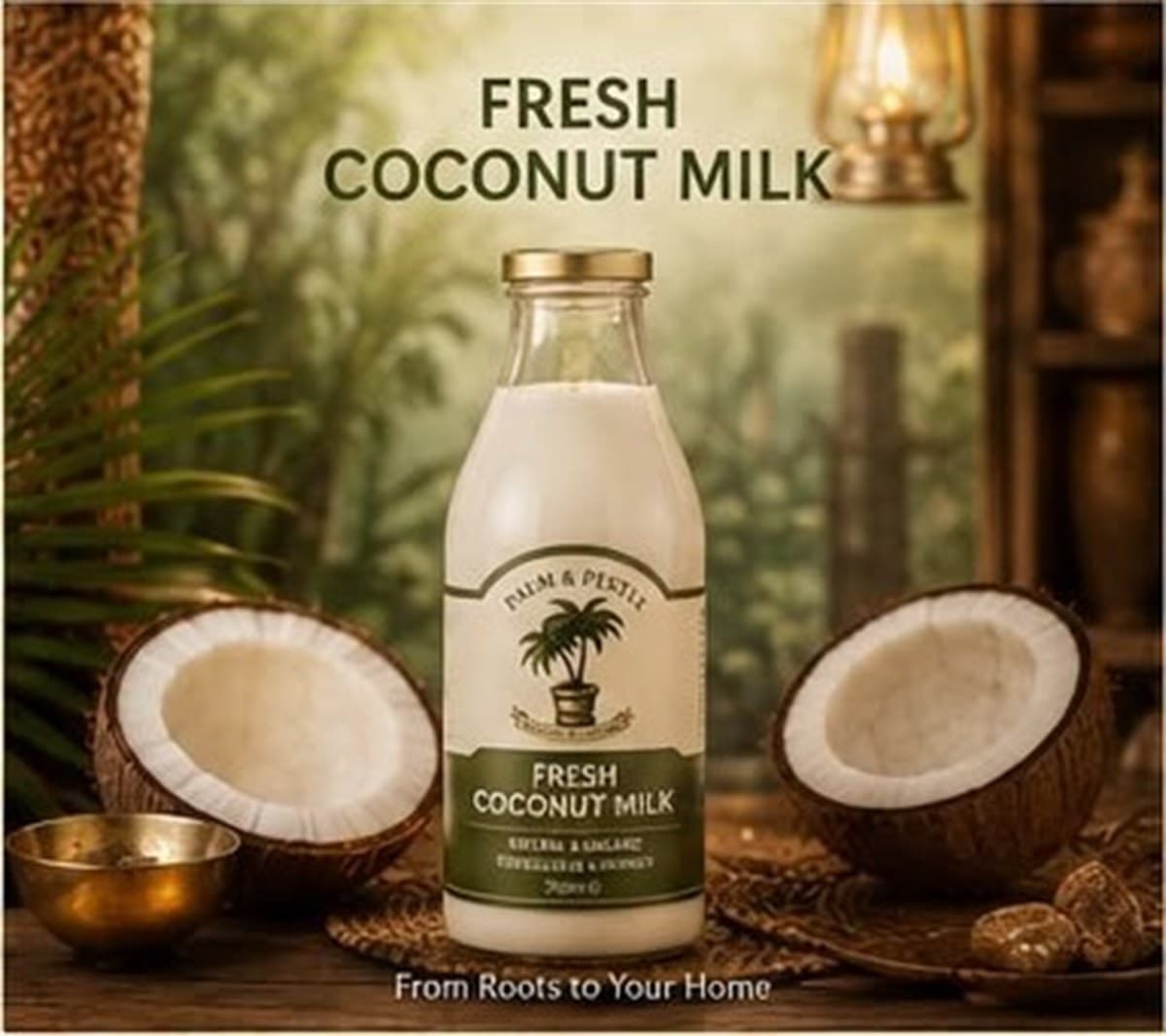
Coconut milk is one ingredient. Fresh coconut, cold-pressed, and packaged. That is the entire recipe. Which makes it strange that most cartons on Indian supermarket shelves contain five to eight ingredients. Here is how to tell the two apart.
What belongs on the label
"Coconut, water" — this is fine, though "water" often means the milk is diluted. Look for a coconut-solid percentage above 20%.
Better: "coconut" alone. Our coconut milk is single-ingredient — 100% fresh coconut, cold-extracted the day it is opened, aseptically packed.
What does not belong
Xanthan gum, guar gum, "stabiliser", "emulsifier", carrageenan, sodium caseinate, coconut water extract, "reconstituted", or any preservative. Each of these is a signal that the product is engineered rather than pressed.
The gums are the biggest tell. They exist to hold industrial coconut milk together — real coconut milk separates naturally into cream on top and thinner milk below. If the tetrapak content stays perfectly smooth for six months at room temperature with no stabiliser mentioned, something is holding it together that is not on the label.
How to test at home
Pour a little into a warm pan. Real coconut milk thickens as it heats and starts to release oil at the edges after a couple of minutes. Industrial coconut milk stays smooth and uniform — the emulsifiers prevent the natural separation and oil release.
Refrigerate an opened bottle for a few hours. Real coconut milk solidifies on top — the cream layer separates and firms up. Industrial versions stay homogenous, held together by their gum.
What separation actually tells you
Every coconut milk that separates is authentic. Every coconut milk that never separates has been chemically stabilised. Separation is a marker of purity.
Shake gently before pouring, or spoon the thicker cream off the top for a curry finish and use the thinner milk for the body. Two ingredients from one bottle.
A short buying checklist
Coconut-solid percentage: 20% or higher (30% is excellent).
Ingredient list: one or two lines, not five.
Packaging: glass bottle or aseptic paperboard — both fine. Avoid canned coconut milk in India (BPA-lined cans are common).
Aroma when opened: distinctly coconut, not neutral.