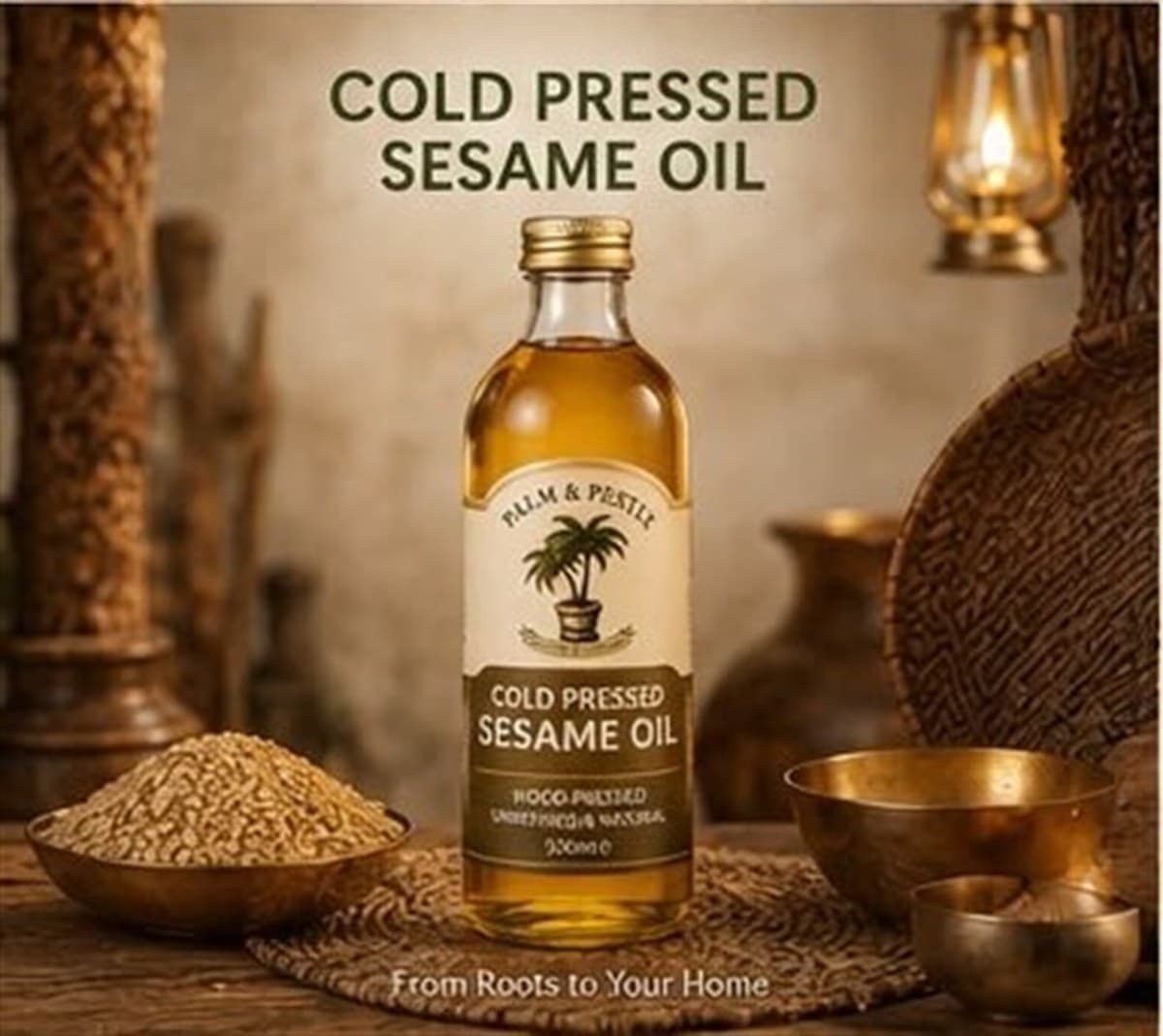
In Tamil, sesame oil is called nallennai — literally "the good oil". Not one of many oils. Not a preferred oil. The oil. The word tells you how central it was, and how central it can be again.
The word
Nal (good) + ennai (oil). The name is old enough that its origin does not matter — it is simply what the oil has always been called. There is no equivalent phrase for refined "gingelly" oil in traditional Tamil vocabulary because refined oil did not exist when the language was young.
The word is a small linguistic proof that this oil was the default. Not a specialty. Not something to be reached for on special occasions. The everyday oil.
The ghani
The traditional press for sesame oil is a wooden ghani — a stone-and-wood mortar with a slowly rotating pestle. Historically the rotation was powered by a bullock walking a slow circle around the machine. Now it is often a low-speed electric motor, but the essential mechanics are unchanged.
The ghani presses at low RPM and low temperature. That "cold press" preserves the delicate compounds — sesamin, sesamolin, vitamin E, aromatic phenolics — that make sesame oil taste and act the way it does. Industrial expeller presses, running at high speed and high heat, destroy most of these.
Our cold-pressed sesame oil is made on a wooden ghani in the Kongu belt of Tamil Nadu, from single-farm black sesame.
What refined "gingelly" oil actually is
Refined sesame oil starts life the same way — sesame seed pressed for oil. Then it goes through solvent extraction with hexane, neutralisation with sodium hydroxide, bleaching with fuller's earth, and deodorising by superheated steam.
What comes out is pale, uniform, odourless, and cheap. And nutritionally hollow. The compounds that make sesame oil useful — sesamin, sesamolin, the antioxidants that give it a long shelf life without preservatives — are stripped in the refining. What is left is essentially neutral cooking fat with the sesame branding.
Traditional uses
Tadka — the mustard-seed crackle at the start of every South-Indian dal, sambar, rasam, and vegetable side. Nallennai is what makes the tadka smell like a South-Indian kitchen.
Oil bath — warm nallennai worked into scalp and hair on a Sunday morning, the traditional Tamil ritual. There is a longer piece on this specifically elsewhere in the journal.
Poriyal — the dry vegetable side, tempered with nallennai, curry leaves, mustard, hill garlic, and grated coconut.
Podi with oil — spice powders mixed with a little nallennai on the plate, eaten with hot rice. The simplest South-Indian meal.
How ours is made
Fresh black sesame from farmer families we have worked with for years. Sun-dried on jute mats. Taken to a wooden ghani in the same village, pressed slowly, unfiltered.
The bottle you receive carries visible sediment at the bottom. That sediment is fine seed particles — the very flavour compounds the refining process removes. Shake gently before use.